

Let's Talk
×
The psychology of UX/UI design is the key to the digital experience. Users don’t just push buttons at random. Emotions, behavior patterns, and mental shortcuts all shape their actions. When a design engages the human brain, it generates trust, less confusion, and more conversions.
Designing is no longer just about the colors and layouts in the digital world today. It is all about knowing human beings, what they observe, what puzzles them, and what pushes them into action. This article examines the psychological foundations of popular UX/UI design and illustrates how companies can apply these insights to enhance click-through rates, trust, and sales.
What is the psychology of UI/UX design?
What does psychology mean in UX/UI design?
The psychology of UX/UI design bridges the gap between human behavior and design preferences. It describes the cognitive processes of users and their thinking, processing information, and responding to various items on a screen. The interfaces become predictable and natural when designers apply psychological principles.
This helps users accomplish their work with minimal effort, develop confidence, and simplify online experiences. Simply put, it is the human mind designing, not the device alone.
What impact does UX/UI psychology have on user behavior?
What is the role of UX/UI design in determining user behavior?
The UX psychology influences behavior in many aspects.
- Attention and focus: It is where the contrast, size, and spacing direct the users' attention to look.
- Moods and graphics: The colors are friendly, rounded, and the microcopy is relatable, thus making users feel secure.
- Aspects of building trust: Clean layouts and clarity lessen uncertainty.
- Foreseeability: There are recognizable patterns that aid in comprehension among users.
- Click behavior and conversions: Buttons, spacing, and urgency cues influence the actions taken.
Users speed up when design aligns with behavior. They can complete tasks without frustration.
Key Psychological Principles in UX/UI Design
Hick Law
"The fewer the number of choices, the quicker the decision."
The greater the number of choices that users have to make, the slower they make them. Short and narrow menus and plain forms enhance conversions.
Fitts' Law
"Placement and size of the CTA matter."
The buttons should be large enough to tap easily and placed in a way that is accessible, especially on mobile devices. A prominent CTA increases clicks immediately.
Visual Hierarchy
"Grab the users' attention."
The size, color, spacing, and contrast inform the users about important things. High hierarchy enhances clarity and reduces confusion.
Color Psychology
"Colors affect trust and have an emotional impact."
Blue is trusting, red is urgent, and green is positive. The selection of colors influences behavior and affects the mood.
Gestalt Principles
"Users see patterns, not parts."
People group related items. Clean grouping helps the user scan and is less demanding.
Cognitive Load Theory
''Simplicity boosts conversions.''
The brain functions optimally when it is less cluttered. Basic and simple designs give users a chance to make decisions.
What Makes Users Click?
Emotional and visual stimuli lead to the behavior of clicking. These include:
- Large contrasting buttons that stick out against the background.
- Harmed CTAs such as "Get Started" or "Book a Demo."
- Psychiatric microcopy that eliminates uncertainty (no credit card is required).
- Patterns of thought reduction that are familiar to us.
- Nudges deal with behavior, e.g., arrows, animations, or progress bars.
Good UI cues assist users in knowing what to click and where.
What Makes Users Trust a Website?
What does UX/UI design do to inspire trust in users?
The trust is increased whenever the interface becomes safe, predictable, and professional. Key trust builders include:
- Clean, modern layouts
- Easy navigation, which is not confusing.
- Social evidence, such as reviews and ratings, is important.
- Security indicators, such as HTTPS, badges, and payment icons.
- Uniform layout with all pages.
A credible site will reduce hesitations and result in more conversions.
What Makes Users Convert?
The conversion is achieved when the design eliminates friction. Key factors include:
- Fewer steps in the sign-up or checkout process.
- Triggers that are based on emotions, like urgency and reassurance.
- Individual flows, such as suggested products.
- Minimal forms of fewer fields.
- Easy navigation, which is predictable.
The conversion-oriented UX/UI takes advantage of psychology to lead the user into action without any hitches.
Psychological Triggers That Improve UX/UI
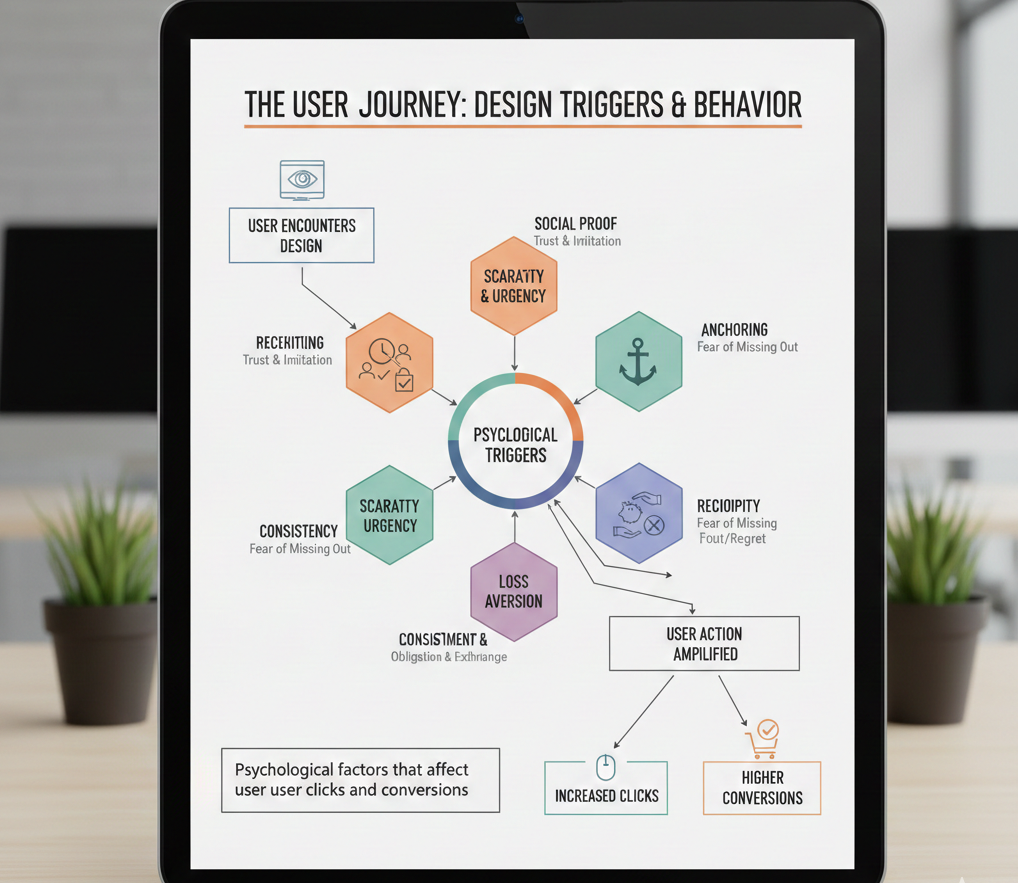
The following triggers are behavior-based and increase engagement and conversions:
- Social proof: 2,000 people have also joined this month.
- Urgency: Only 3 left or a countdown timer.
- Anchoring: When the new price is displayed with a high initial cost, it makes the new price appear lower.
- Loss aversion: Customers are afraid of losing gains—don't miss your offer.
- Reciprocity: The user is likely to reciprocate the free value.
- Consistency bias: The users make decisions that fit their personalities.
A good UX designer utilizes these triggers to their advantage and tricks users into making.
Top UX/UI Design Failures That Can Kill Conversions.
Some sites fail due to mistakes that could have been avoided, such as:
- Disorganized screens that overwhelm users.
- Too many options lead to paralysis in decision-making.
- Weak copy, poor placement, and CTA design.
- Color inconsistency, button differences, or layout issues.
- Dark patterns that violate trust.
- Poor mobile design, e.g., small buttons or cluttered spacing.
Fixing these errors quickly boosts user behavior and conversion rates.
FAQs
1. What is UX psychology in simple terms?
The psychology of UX is the investigation of the way in which humans think, feel, and act in relation to a digital product. It assists designers in developing smooth, clear, and comfortable experiences for users.
2. What is the influence of UI design psychology on user trust?
UI design psychology builds trust by providing a clean layout, powerful visual images, branding, and navigation. When a design looks modern and professional, users feel safer and more confident right away.
3. Which psychological principles improve conversions?
There are Hick's Law, Fitts Law, color psychology, visual hierarchy, and cognitive load theory, which have their implications on conversions. They help users decide more easily and at a lower cost during important tasks.
4. Why do colors matter in UX/UI design?
Colors influence feelings and make a choice. They show confidence, hurry, euphoria, or tranquility. Certain colors are employed by brands to predict the mood and make the user feel at ease while surfing.
5. How can businesses use psychology to improve their websites?
Companies can simplify layouts. They can use clear calls to action. They can also include social proof, and reducing cognitive load is another option. Finally, creating a predictable flow helps too. These modifications make users believe in the brand and take more actions with ease.
Conclusion
The psychology of UX/UI design is very influential in determining user clicks, trust, and conversion. When companies are designed in such a way that caters to the human mind, they make things easier and more engaging. Brands will be able to increase conversions and establish long-term customer trust by applying smart UX psychology and emotional design.
If you want a fast site based on practical psychology, Digiexpo can help. Contact Digiexpo today to transform your digital experience.